Shock Your Potential
How do you Shock Your Potential? This conversational interview format features high performing businesses, organizations and entrepreneurs who are focused on Shocking Potential every single day. Each month boasts a theme that will support your business and/or career objectives, will strengthen your personal development, motivate you to be an agent for change, and more. Our Host, Michael Sherlock, may not look or sound like your typical podcast host, but she is absolutely serious about business and brings out the energy and dynamic character of every guest. This podcast is definitely worth a listen!
Listen on:











Episodes
Tuesday Jul 20, 2021
Tuesday Jul 20, 2021
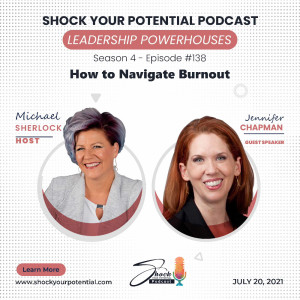
“As a leader, no matter where you are, you must have boundaries and be clear about what is okay.” Jennifer Chapman
The lack of boundaries at the workplace has been identified to be among the primary root cause of burnout among leaders. The dilemma that most leaders face, therefore, is how can they establish healthy boundaries at work? Our guest today, Jennifer Chapman, advocates for leaders to set healthy boundaries by identifying their areas of interest and delegating all other tasks for better productivity and increased engagement with their teams.
Jennifer Chapman used to be a workaholic, known as the go-to person for getting things done and managing the most difficult clients at a Fortune 500 consulting firm. She thrived in challenging situations, proving to others time and time again that she was invincible. Eventually, Jennifer’s mental and physical health began to suffer, so she decided to create a new professional and personal life that aligned with what she valued most. She created the job she wants and a new independent confidence, and she continues to bring her authentic self into all of her work. She is more successful—in terms of happiness, financial security, and her ability to help others— than she has ever been.
Today, Jennifer is an expert leadership coach, working with STEM managers and leaders who want to increase productivity and performance by strengthening their confidence and people skills. When Jennifer isn’t developing the next generation of influential leaders, she can be found spending time with her husband and five children and hitting the trails with their beloved dog!
In today’s episode, our guest will talk about the benefits of delegation in leadership. She will also shed more light on why setting boundaries in leadership is ideal and how managers can learn to let go.
Listen in!
Social Media
www.ambitionleadership.com
www.linkedin.com/in/coachjenniferchapman/
www.facebook.com/ambitionleadership
I have lived in a bunch of different places and I am a mum to two biological kids and three awesome step kids. [4:00]
I have a lot of accountability to myself and to others to make sure I am taking good care of myself. [5:14]
I left the consulting firm I was working for on leap day and the first year and a half was super scary. [11:24]
When I was at the consulting firm, I had the opportunity to work at a scientific organization as a consultant, onsite for three years. [6:10]
I noticed that I enjoyed working with all these different kinds of scientists. [6:24]
I have a gift of showing those with a more scientific, data-driven, task-focused mindset why paying attention to the people side of things is going to help them and their bottom line. [6:53]
I am also married to a mechanical engineer, and it has been a great partnership. [7:11]
If you keep hanging on to responsibilities and you don’t shift what your perspective is as you move up in an organization you will burn out. [9:42]
I often have my clients organize their duties and responsibilities into tasks that energize them and those that deplete them of their energy. [10:15]
They then delegate the things that drain them to get as many of those things off their plates then they are left with the work that they love. [10:28]
I love to find out from my specific clients where the breakdown is happening to help them personally to get to a place where they feel confident delegating and making room for the work they love to be doing. [11:26]
One thing to keep in mind is whatever you say yes to, you are saying no to a whole bunch of other things, and the opposite is true. [13:10]
I find it easier for stem leaders to let go when they can keep their minds focused on what it is that they want and whether the things they are doing are going to have more of it. [13:34]
In my previous position, I was often asked by the people above me who my second team was and which people I was training to take my place so that when I get promoted, there would be someone to take the lead. [14:35]
In the science industry and tech industry, there is usually one right way to get from point A to point B, yet it is not that way all the time in other things. [15:33]
If you think more about what needs to get done instead of how it needs to get done, you will be able to empower your direct reports with so much more autonomy. [15:50]
As they have those experiences their confidence increases and they are grateful to you for giving them the experiences. [16:05]
Commercial Break. [16:38]
When the intelligence and accomplishments of applicants are the same when deciding to offer someone a position, the soft skills or people skills will be the differentiator. [19:20]
A lot of people who have gotten ahead in their career without worrying about it are realizing that to be competitive and be employed, they have to stop and think about it. [19:34]
I work with clients to help them be clear about what is theirs to own and what is not theirs to own. [23:45]
You’re the leader and guide, but it is not entirely up to you to make everybody this perfect person that a lot of people never become. [27:19]
As a leader, no matter where you are, you must have boundaries and be clear about what is okay. [28:25]
Before you chastise your direct reports for not having good enough boundaries and avoiding burnout, look at your behaviors and ask yourself if you are modeling what you are asking them to do. [31:20]
………………………………………………….
Thank you to our July Sponsor: Entrepreneur’s Guide to Financial Well-Being
Imagine starting a long journey without a map…or even a clear idea of the obstacles ahead. That’s exactly what it’s like for entrepreneurs who start companies with a lot of passion, but without the financial expertise to grow and scale their businesses and create long-term wealth for their families.
Wayne Titus shows you how to find a financial adviser who can help you map a better journey. In his book, The Entrepreneur’s Guide to Financial Well-Being. With the right adviser at your side, you’ll have the freedom to focus on what really matters to you.
Get The Entrepreneur’s Guide to Financial Well-Being at Amazon.com and in the virtual bookstore on the Shock Your Potential app.
Monday Jul 19, 2021
Monday Jul 19, 2021
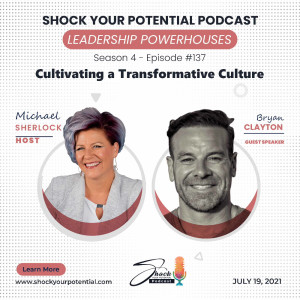
“You as the owner and leader of your business, you get exactly the culture, vibe, and company that you deserve” Bryan Clayton
Every entrepreneur has a unique account of how their entrepreneurship journey unfolds. There are however very key similarities in all these stories among them being resilience and continuous transformation. Our guest today, Bryan Clayton is a seasoned entrepreneur and leader in his own right. He shares with us his unique journey to business success and insists on the importance of factoring in people aspect in your transformation plan.
Bryan Clayton is the CEO and co-founder of GreenPal, an online marketplace that connects homeowners with local lawn care professionals. GreenPal has been called the“Uber for lawn care” by Entrepreneur magazine and has over 100,000 active users completing thousands of transactions per day. Before starting GreenPal, Bryan Clayton founded Peachtree Inc., one of the largest landscaping companies in the state of Tennessee growing it to over $10 million a year in annual revenue before it was acquired by Lusa holdings in 2013. Bryan‘s interest and expertise are related to entrepreneurialism, small business growth, marketing, and bootstrapping businesses from zero revenue to profitability and exit.
In today’s episode, our guest will be giving us practical and key leadership lessons and tips that are instrumental in running successful businesses and which listeners and viewers will find insightful.
Listen in!
social media:
https://www.yourgreenpal.com
http://linkedin.com/in/bryan-clayton-5178541b8
https://twitter.com/bryanmclayton
https://instagram.com/bryanmclayton
I am the CEO, co-founder of Greenpal and I have been at this company for 8 years, with several hundreds of thousands of customers using the app to get their grass cut and doing $20 Million a year in revenue. [3:08]
Before Greenpal I had a landscaping company that I grew from just me and a push mower to 150 employees which got in $10 million a year in revenue over 15 years. [3:29]
I was able to get the business acquired which doesn’t happen so often in the landscaping industry. [3:42]
Growing that first business I learned a lot about how to grow and scale a business, leadership, how to become a good leader, and how to get people rallied around what the objective is and getting them to want to come to work every day. [3:47]
I applied everything I learned in the first fifteen years of business into the second company which is a tech company. [4:20]
One thing I have learned, is that business can cause you as the founder or owner to be a better leader. [4:41]
You are constantly going to be evolving every so often and that means that you are doing things right. [5:07]
One of the growing periods I went through and I was a terrible leader and boss and I had to evolve and grow. [6:27]
You as the owner and leader of your business, get exactly the culture, vibe, and company that you deserve. [7:10]
That was a tough pill to swallow but was one that I had to learn the hard way [7:34]
I decided that I was going to make it fun again. [7:46]
I tried to align the company’s success with what my people wanted in their life. [8:07]
I started a program where we were giving out interest-free loans, and as the staff grew in number, the program ballooned and became the why behind what the whole company did. [8:20]
It galvanized the whole team into one solidary force where key things like quality and timeliness took care of themselves. [9:33]
The reason why the business was able to be sold is that we had a good culture and low employee turnover [9:54]
When the leader tries to fix culture, it’s got to be actionable, practical, and real. [12:20]
There was a big gap between my previous company and the current company that I did not understand. [14:28]
I believed that starting a software-based company would be easier than what I was previously doing but I was so wrong. [15:02]
I recruited two co-founders who were as relentless and hardworking as I tried to be and I could tell that they wanted something more out of life. [15:10]
With Greenpal everything was new and it was difficult forging my way through the unknown. [16:01]
It took us three years to build what we believed Greenpal should be while teaching ourselves software development as well as marketing and distribution of the software. [16:21]
With putting in the time and hard work we started to see evidence of it working and started bringing specialists and people that were better at the roles than we were and build a team. [17:02]
Now we have a team of twenty-five people and most are smarter than me. [17:14]
It is a fun thing to build a business where you walk in and most of the people are smarter than you. [17:20]
It has been 8 years in the business and I am glad that I did not give up because it has all been worth it. [17:40]
You have to do interesting things in your life to live an interesting life. [18:51]
My business is the storyline of my life and if it weren’t for the ups and downs, it wouldn’t be as interesting. [18:59]
Commercial Break. [19:35]
If you are going through a crisis, then don’t nibble at it. It is not happening to you but for you and maybe 5 years or less from now, you will be glad this happened. [21:46]
A lot of times as leaders, the easiest mistake we always make is holding on to B, C, D players when we need to flash that out and get lean. [22:18]
When you are a founder of a small business of between 15 -20 people, you have to be good at both. [25:10]
It is constantly being aware of the difference between a good manager and a good leader. [26:18]
………………………………………………….
Thank you to our April Sponsor: Entrepreneur’s Guide to Financial Well-Being
Imagine starting a long journey without a map…or even a clear idea of the obstacles ahead. That’s exactly what it’s like for entrepreneurs who start companies with a lot of passion, but without the financial expertise to grow and scale their businesses and create long-term wealth for their families.
Wayne Titus shows you how to find a financial adviser who can help you map a better journey. In his book, The Entrepreneur’s Guide to Financial Well-Being. With the right adviser at your side, you’ll have the freedom to focus on what really matters to you.
Get The Entrepreneur’s Guide to Financial Well-Being at Amazon.com and in the virtual bookstore on the Shock Your Potential app.
Friday Jul 16, 2021
Friday Jul 16, 2021
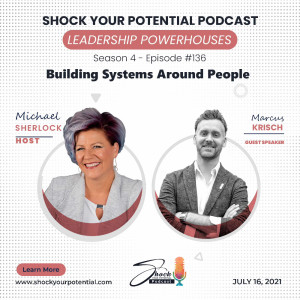
“Communicating is the most essential piece in successful change and transformation.” Marcus Kirsch
Organizations have always been faced with complexities that have negatively affected how things get done. The belief by most leaders that technology can solve these complexities and enhance productivity has led to many organizations spending a lot of resources to acquire the latest technology, only for the solution to fail in meeting the expectations. However, research continues to show that the people factor is the key to solving these complexities. Today, our guest, Marcus Kirsch, has been working with organizations to address these complexities and believes that the problem can be addressed only if the focus is shifted to consider people aspects when building organizational designs.
A Royal College of Art alumni and ex-MIT Media Lab Europe researcher, Marcus Kirsch has worked as a transformation, service design, and innovation specialist for over twenty years. With project experience for companies like British Telecom, GlaxoSmithKline, Kraft, McDonald's, Nationwide, Nissan, Science Museum, P&G, Telekom Italia, and many others, he believes that we need a new narrative, mindset, and way of working to align ourselves with what society needs today. When Marcus is not hard at work, he is a mediocre indoor climber, movie nerd, and maker. He currently resides in London, UK. The Wicked Company is Marcus's first book.
In today’s episode, our guest will be discussing the people factor, which not only entails those within the organizations but customers as well. He will also use real-life examples to discuss the importance of communication when leading teams to enhance effectiveness.
Listen in!
Social Media
https://twitter.com/wickedandbeyond
https://medium.com/@wickedandbeyond/
https://www.linkedin.com/profile/view?id=AAIAAAEd_uABHXoQckMMTb9el6M_ybXrm6VQtCs&trk=nav_responsive_tab_profile
https://www.thewickedcompany.com/podcast/
My background is in art, innovation, and tech, and I have moved over the last twenty years from getting my hands dirty working for a variety of clients and companies to getting more interested in building the context for that kind of work to be able to happen. [2:03]
When you work in innovation or are in a creative area, you see a lot of ideas that never come to fruition, and sometimes that has to do with the organization itself. [2:23]
I started to focus on the people aspect of things, and what it actually needs for organizations to thrive and create more value, so I moved into management consulting, and that is what I do today. [2:44]
When creating things, the people aspect is the more complex aspect, and what I am focused on is the teams who create those things and the leaders who enable them [4:17]
I had looked at the complexity of creating things and the challenge this has for many years [4:40]
I found the idea of the wicked problem identified back in the 60s as the problem of urban planning was being solved [4:58]
Most of today’s problems in social media, services products around people keep evolving because people keep reacting to it. [5:50]
I looked back at how organizations function and realized that this is probably one of the main reasons why a lot of IT investments and investment in change and transformation just doesn’t work [6:05]
The big part is a lot of things we can't quite measure but only check effects which is a lot of emotional aspects around technology behavior and change. [6:42]
There are interesting new practices out there like service design and behavioral science, which start looking at those aspects as major drivers for things like sales, customer reactions, and how teams are built and thrive. [6:54]
When we look at the research on change and transformation projects, and we see they have failed to significantly deliver on proposed value, then we know it is not working. [8:08]
It is nearly an industry in crisis, and the crisis is there because both leadership and people themselves have been organizationally trained not to look at the people aspects. [8:24]
It has never been easier and cheaper to go out and talk to customers or people in the workplace, so there is no excuse anymore for organizations not to do this. [13:27]
However, often the echo of the hierarchy is strong, and therefore it still happens, and therefore that is one of the things which we have to let go. [13:48]
That naturally moves us to a shift of governance and decision making and who we ask. [14:00]
You have to go out and ask questions not to just make things better for people but to identify crucial things that have been missed out. [18:15]
One of the principles we adopt when we go into projects is to treat everything as an assumption. [19:17]
Commercial Break [22:50]
Communicating is the most essential piece in successful change and transformation [24:12]
50 % of successful transformation is about communicating, clarity, and admitting that you don't know everything but being clear enough with the vision [24:20]
It is odd to look back 20 years where we were having leaders that tended to be at a higher age and were less familiar with digital than the younger crowd who grew into it; there was less literacy than a digital one [24:42]
It is important for leaders to understand that they don’t have all the answers and should allow the people who work for them to more heavily contribute which then pushes a different mode of governance. [26:25]
Acknowledging that you are biased and having your teams being able to question what priority you are setting on certain business values or how to achieve them is important. [27:39]
Bringing all the language between the different functions together so that they can communicate to each other because if they cannot communicate, then you cannot compare or even have a conversation and therefore can't make a decision. [28:06]
This where you want to get to the top and bottom levels of leadership and even, to some extent, include the customer in the process [28:27]
Sometimes you find the companies or brands have already moved together but oddly enough find that the teams in the organization and leadership are not together. [28:40]
If the top-level and teams are talking the same language, you can have knowledge transfers that are of major benefits to the organization. [29:55]
I like simple, practical things and enjoy what people can do, and they can do it when they communicate best together. [33:45]
The first few steps are exponentially more important than anything after because anything after increases the cost exponentially if gotten wrong. [36:35]
Don't glorify busy; take the time to step back and ask why [38:50]
The risk that organizations are taking by overproducing is dangerous and therefore doesn’t glorify busy but rather give people time to work nine to five. [39:15]
………………………………………………….
Thank you to our July Sponsor: Entrepreneur’s Guide to Financial Well-Being
Imagine starting a long journey without a map…or even a clear idea of the obstacles ahead. But, unfortunately, that's exactly what it's like for entrepreneurs who start companies with a lot of passion but without the financial expertise to grow and scale their businesses and create long-term wealth for their families.
Wayne Titus shows you how to find a financial adviser who can help you map a better journey. In his book, The Entrepreneur's Guide to Financial Well-Being. With the right adviser at your side, you'll have the freedom to focus on what matters to you.
Get The Entrepreneur’s Guide to Financial Well-Being at Amazon.com and in the virtual bookstore on the Shock Your Potential app.
Thursday Jul 15, 2021
Thursday Jul 15, 2021
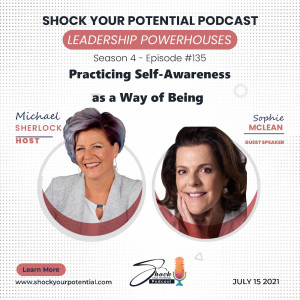
"If you reach this place of peace and harmony in your life, then whatever you are up to in your business will be directly impacted and will be a direct reflection of your internal state.” Sophie McClean
The concept of self-awareness may sound simple and straightforward, but most people find it difficult to practice it. The importance of practicing self-awareness is, however, critical and most especially for leaders since it determines how efficient they are in leading and winning others. This is according to our guest today, Sophie McClean, who believes that there is limitless power in self-awareness.
Sophie McLean's mission is to contribute to the creation of a new culture for humankind, or the shift from Homo Sapiens to Homo Spiritus, as Dr. David Hawkins so beautifully wrote. Born in Algeria, educated in Morocco and France, with a professional career in the USA and UK, Sophie has led an eventful life. She has been a helicopter pilot, a teacher, a designer, a relief worker, a war refugee, a CEO, and served as a United Nations representative on The Commission on the Status of Women's Hunger Project. She has been shot at, shipwrecked, and widowed. She has lived on a farm, a boat, a penthouse, and in an ashram.
As a wisdom teacher, Sophie has spent decades leading transformational seminars to over 80,000 people around the world, of all ethnicities, ages, religions, and social backgrounds – all engaged with the universal existential questions of "Who and what am I?" and "What is my life about?" Her seminar and podcast topics span both human and metaphysical dimensions – exposing and deconstructing the automatic ego, consciousness, freedom, love, stress, anxiety, fear, relationships, health, sex, money, ownership, leadership, spirituality, creation and evolution, the feminine and the masculine, responsibility, and making an effective, actionable difference in the world.
Sophie engages people in a rigorous review of their life and systematically questioning their conclusions on the basis that without examining our network of ideas, beliefs, social and cultural judgments, and our assumptions about the world, those are transformed into constraints. Her interest is in the nature of what it means to be human.
In today's episode, we will be diving into the world of self-awareness to discuss the importance of stepping back and slowing down to first understand the self before stepping out to lead people. Our guest will as well be telling us why she believes that non-attachment is a great quality when it comes to effective leadership.
Listen in!
Social Media:
https://sophiemclean.com
https://www.linkedin.com/in/sophiemcmclean/
https://www.facebook.com/smc.mclean
https://www.facebook.com/groups/Thinkingconsciously / https://www.instagram.com/sophiemclean.accesstoawareness/ https://www.youtube.com/channel/UCrZBvM6bUXstyoB1uIhIxzg?view_as=subscriber
I have always had this impulse of leading an extraordinary life. [2:37]
One of the biggest risks for me is to examine who we are as human beings and to elevate our consciousness constantly. [2:55]
I moved back to New York in 2019 and started a business called access to awareness, and I was committed to giving the gift of awareness to people. [3:44]
Everyone has that gift but has not practiced and realized that awareness is the ultimate power [4:03]
It is all about examining what your life is all about, who you are, your mission and what you want to accomplish. [4:34]
If you reach this place of peace and harmony in your life, then whatever you are up to in your business will be directly impacted and will be a direct reflection of your internal state [6:40]
Many people at the beginning of the pandemic were telling me they can't wait to go back to the way things were before the pandemic, but now they are saying they don't want to go back but move forward. [7:03]
That is the evolution of human consciousness from Homo Sapiens to Homo Spiritus. [7:16]
There is pain, fear, and anxiety, but the faster we dive into that shift, the quicker the pain will disappear. [8:10]
If we resist and try to hold into what we had, then the suffering becomes more intense. [8:28]
The question in my mind, which I don't have the answer to, is how much light needs to be shone on how many things before we shift our consciousness. [10:07]
If you hold a context that it is all perfect and fall in love with reality, and you are able to dance with whatever the symphony of life is, then you will be able to weather it well. [11:01]
There are two kinetic energies in elevating self, and one is the space of love while the other one is suffering. [12:55]
The problem is, if we look at the history of humankind, we have always elevated ourselves through suffering. [13:12]
The possibility of practicing awareness as a way of being is to not go to the suffering before you are awake. [13:37]
Before the pandemic, we were so busy, and there was so much noise that we never took the time to slow down. [16:16]
Mostly with leaders, the first thing I have to do is teach them to slow down and having them see it as a pleasurable, worthwhile, useful, and life-giving distinction. [16:35]
Commercial Break [17:51]
When I started my business two years ago, I was by myself; I experienced a kind of force field where the business was pulling me to do things the way everybody else was trying to do. [19:36]
I can't do everything like everybody else and be unique; that is by definition not possible. [20:08]
When you bring awareness and realize that there is this world of agreement and that if you start into it, you will disappear into it, then you need to stand [20:41]
The only way I am going to deal with this force field while not giving up on my business would be standing right there in my commitment and what I want to produce. [21:32]
You need to give up doubts, guilt and give up attachment [21:45]
Non- attachment is great for leadership because then you are free, which allows for self-expression, listening, communication, and risk-taking. [23:22]
The universal rule is you always reap what you sow [25:50]
If you are attached, you literally tie yourself somewhere, and you can't move. [26:00]
Resources
The Call of the Soul [Free Course]
Your Soul's Journey [5 Month, Live, Online deep dive]
………………………………………………….
Thank you to our July Sponsor: Entrepreneur’s Guide to Financial Well-Being
Imagine starting a long journey without a map…or even a clear idea of the obstacles ahead. That’s exactly what it’s like for entrepreneurs who start companies with a lot of passion, but without the financial expertise to grow and scale their businesses and create long-term wealth for their families.
Wayne Titus shows you how to find a financial adviser who can help you map a better journey. In his book, The Entrepreneur’s Guide to Financial Well-Being. With the right adviser at your side, you’ll have the freedom to focus on what really matters to you.
Get The Entrepreneur’s Guide to Financial Well-Being at Amazon.com and in the virtual bookstore on the Shock Your Potential app.
Wednesday Jul 14, 2021
Wednesday Jul 14, 2021
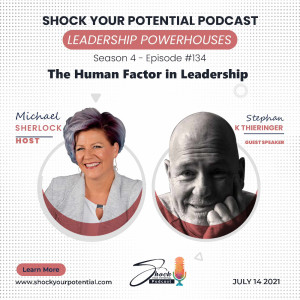
“It is important to let people know that they matter, what they do for the company matters and giving them transparency on the impact that they have on the business.” Stephan Thieringer
People are constantly faced with expectations from their environment which most often makes them feel pressured and as a result anxious. The pandemic has further catalyzed the situation considering the highly paced change and complexities that have arisen due to the crisis. This has resulted in many leaders pausing to reflect on how they can better lead to attain greater success as well as fulfillment. One of the ways they can bring purpose in practice is through embracing the human factor in their engagements with their people. Our guest today; Stephan Thieringer, believes that relationships should be built in accordance with human needs.
Stephan K Thieringer is a Business Thinker, Innovation Strategist, and Executive Coach. His recent company, The Human Innovation Garage, is a leading coaching and advisory firm, working at the critical intersection of talent and business. Stephan has been recognized by the WHRC and WCC as a 2020 World’s 101 Top Coaching Leader and received various other global and national accolades. Stephan is passionate about inspiring people and transforming organizations and the culture of organizations.
As a serial entrepreneur with many disappointments and failures and some successes, Stephan is passionate about reminding people of the human factor and creating a space for high performance buy being and living. Stephan has keynoted events around the world, engaged deeply in education technology and education impact, and equal access. He serves on several company boards, is an angel investor in over a dozen companies, and recently became a shareholder in a football club [soccer]. Stephan is originally from Stuttgart, Germany, and resides currently in Boston MA.
In today’s episode, Stephan discusses the concept of humanity and why it should be embraced by every leader when they are interacting and building relationships with their people.
Listen in!
Socials
https://www.linkedin.com/in/stephanthieringer
https://www.instagram.com/stephan.thieringer/
https://www.facebook.com/humaninnovationgarage
Human Innovation Garage is my company name and it explains what we do and also what we stand for in philosophy and value. [4:15]
The factor of Human in humanity includes everything from humility to humanity and if we look at human beings and who we are on an individual basis, we can all find brilliance within us. [4:30]
If we as human beings start looking at all the inherent brilliant pieces that we have and assemble them differently and be more tolerant and understanding of each other, it can be an important component of building a high-performance culture. [5:20]
The third piece is ‘Garage’, whereby normally a garage has its tools, processes, structures, and procedures. [5:48]
People need to have structure, what I like to call rituals and habituations. [6:00]
One of the biggest pieces we miss and don’t talk enough about and companies are also afraid to talk about particularly after 2020 is trust. [9:02]
From a very young age, we are very much a product of our surroundings. [9:34]
What is fascinating to me in the work I do and I have done with people is the realization that everybody has the same issues. [10:05]
The reason people are afraid to engage is the lack of clarity of what is the result for them because nobody gives them any kind of resources to draw that avatar of themselves. [10:40]
A trigger is ultimately the awareness of what is happening in the moment of a given situation that a person is in. [11:28]
When we give a keynote, we are not saying anything new but the way we phrase it hits somebody. [12:32]
If there is something that you can connect with, it becomes real and meaningful and its absence makes people not engage. [12:50]
When I work with organizations on how they give each other feedback, it’s more about how they clarify what they need and to what extent. [15:43]
When it comes to relationships, it is not about ‘I need you to do,’ but rather it is about, ‘when you do it makes me feel,’ and this allows people to respond. [15:58]
Tools are not just big box with hammer and nail and screwdriver but also is the structure and model of an empathetic conversation or clarifying information. [16:07]
Work-life balance does not exist anymore, but rather work-life integration. [16:50]
There is a traditionalist approach to micromanagement because my generation is used to having people in the organization, which makes us feel good. [17:08]
We need to understand that there are five generations in the workforce, where the latest two are very comfortable working remotely. [17:38]
The problem is that the people who manage them are not comfortable with the mode of working remotely. That is however not the way it is going to work. [18:02]
I work with senior executives to find a way to help them not be triggered by the demands they are not comfortable with to ensure responsiveness, inspiration and that they will be willing to do much more than is required of them. [18:30]
The unfortunate part is that CEOs almost need to permit employees to exercise self-care. [20:48]
Trust is built by knowing that you care about me and my wellbeing. [21:03]
Commercial break. [21:21]
We have a lot of people who are actively disengaged where they choose not to do what they are asked by conscious choice. [27:20]
It is important to let people know that they matter, what they do for the company matters, and giving them transparency on the impact that they have on the business. [27:35]
Job fit and boss fit are the top reasons why people leave companies. [28:20]
We did a survey which indicated that close to 70 percent of people who are employees said that their bosses were not managing them effectively. [28:32]
What that says is that we don’t build relationships in accordance with what human beings need. [29:15]
There are four E's in our lives and they are all fundamentally different which include Education Emotional, Experience, and Expertise. [32:40]
If I accept that whatever perspective you are sharing comes from the 4 E's that are relevant to you, and I share from those that are relevant to me, there is absolutely no doubt that the perspectives will be fundamentally different. [33:06]
It allows me to make space for that and inquire and shut down the judgment and dismissal. [33:26]
When we talk about humans, the first human we need to talk about is ourselves. [35:56]
When you think about the ‘if’ turn it into a ‘when’, and the when will become a commitment and becomes the requirement for you to make a strategy on how to get there. [36:06]
………………………………………………….
Thank you to our July Sponsor: Entrepreneur’s Guide to Financial Well-Being
Imagine starting a long journey without a map…or even a clear idea of the obstacles ahead. That’s exactly what it’s like for entrepreneurs who start companies with a lot of passion, but without the financial expertise to grow and scale their businesses and create long-term wealth for their families.
Wayne Titus shows you how to find a financial adviser who can help you map a better journey. In his book, The Entrepreneur’s Guide to Financial Well-Being. With the right adviser at your side, you’ll have the freedom to focus on what really matters to you.
Get The Entrepreneur’s Guide to Financial Well-Being at Amazon.com and in the virtual bookstore on the Shock Your Potential app.
Tuesday Jul 13, 2021
Tuesday Jul 13, 2021
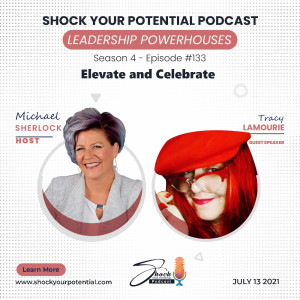
"A rising tide sails all boats" Tracy Lamourie
Public relations is often viewed to be a necessity for only specific and limited entities and individuals. However, according to our guest today, Tracy Lamourie, this belief is not accurate whereby she believes that PR is for everyone regardless of where you are and what you do in life. If done correctly, Tracy believes that people can take advantage of the opportunities to build their brands and elevate themselves positively.
Tracy Lamourie is a high-profile international award-winning publicist and the Founder and Managing Director of Lamourie Media Inc., which is a Universal Women's Network 2020 Woman of Inspiration Winner for the Women In Media award. She is also the author of the upcoming book GET REPPED - Build Your Brand With Effective Public and Media Relations. Tracy is passionate about amplifying important messages and being a voice for those who most need one. She has been recognized by media around the world for her 20-year campaign that ultimately helped free an innocent man from death row and for her work of getting clients major media attention and for her local community work. She is the winner of the FIRST PLACE PLATINUM award Hamilton Spectator for PR and also a frequent guest on TV, radio, and high-profile podcasts around the world on topics of leadership, empowerment, and entrepreneurship as well as all aspects of media and public relations. She is a 2020 RBC Women of Influence Nominee and was recently nominated for the internationally prestigious 2020 Tällberg/Eliasson Global Leadership Award.
In today's episode, our guest will be discussing on why you should be considering giving more positive attention to your image and how to do it through a PR agent. She will also highlight the importance of fostering good relationships even as you put yourself out there as a leader.
Listen in!
Social Media
https://www.facebook.com/lamourie/
https://www.linkedin.com/in/tracylamourie/
https://www.instagram.com/tracylamourieprmedia/
People hear PR and think it is about celebrities or politicians who might need some spin-doctoring. [1:49]
My job is to elevate and celebrate what people are doing, whether it is creative people, celebrities, or entrepreneurs [2:05]
No matter what you do, there are media opportunities for you not just in your industry, but also in the mainstream. [2:32]
New entrepreneurs can access the PR options as long they understand a few key things that help you build bridges [3:02]
A lot of people are great at what they do but don't think of themselves as potentially being in media or winning awards [5:28]
The people who appear in media and win awards probably knew about how to go about it, or they had a publicist who put them out there [5:44]
Being featured in media elevates your brand by improving your SEO, gives you an advantage over your competitors and attracts customers as well as excites your current customers [7:07]
Finding an experienced PR person helps simplify the work, which would typically take a lot of time [9:50]
Commercial break [11:48]
What I guarantee my clients is my excellent work, my contacts, and my connections. [13:02]
There is nothing wrong with celebrating your accomplishments and talking about them. [4:52]
There is a difference between arrogance and confidence. Arrogance has a smirk and confidence has a smile. [15:05]
Find opportunities to elevate other people [16:30]
If you have good people and you do well to them, they also do good to you. [18:46]
It is all about relationships and lifting people up. [21:09]
So be kind to people regardless of the position they are in. [21:15]
It doesn't matter what you do; there are media for you. [22:25]
I am a bigger critic of my work than you are. [23:25]
We did not get this far only to get this far, we can keep going, and there is more to go. [23:51]
………………………………………………….
Thank you to our July Sponsor: Entrepreneur’s Guide to Financial Well-Being
Imagine starting a long journey without a map…or even a clear idea of the obstacles ahead. That’s exactly what it’s like for entrepreneurs who start companies with a lot of passion, but without the financial expertise to grow and scale their businesses and create long-term wealth for their families.
Wayne Titus shows you how to find a financial adviser who can help you map a better journey. In his book, The Entrepreneur’s Guide to Financial Well-Being. With the right adviser at your side, you’ll have the freedom to focus on what really matters to you.
Get The Entrepreneur’s Guide to Financial Well-Being at Amazon.com and in the virtual bookstore on the Shock Your Potential app.
Monday Jul 12, 2021
Monday Jul 12, 2021
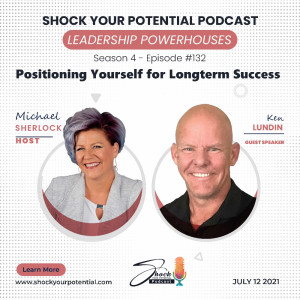
“You need to connect your team’s personal desire and growth with how the company gets them there.” Ken Lundin
When it comes to sales, the focus of the majority of leaders is on hitting the numbers. There is, however, far much more that sales is about, as we shall learn from our guest today, Ken Lundin. With businesses facing new complexities due to the pandemic, Ken believes that to succeed, leaders have to review how they and their teams operate and be more deliberate in ensuring that their strategies are aligned with the current realities.
Ken Lundin is the founder of Ken Lundin & Associates and creator of the Sales Alpha Roadmap. He found his mission while standing on his front lawn in Atlanta in 2011 when he learned from the people who had purchased it that the bank had sold his house. With his business – and the last six years of his life - up in smoke, he took a mid-level sales position and over the next two years was offered two promotions attaining the role of SVP of Sales within two years. With his unique perspective on thriving during difficult times and his considerable sales understanding, he soon became a consultant in order to bring his systematic process to other companies, helping them adapt to complex changes and to thrive in uncertain times
Undoubtedly, sales are much harder to come by in the "new normal" of the COVID era. On average, companies have less than 25% of their sales staff meeting quotas successfully. However, Ken's process is rooted in an understanding that it may be unusual today's difficulties are not unique. Businesses always have and will always need to pivot how they connect with and sell to their customers as times change, and, with this need in mind as well as a keen awareness of what exactly is at stake for entrepreneurs, Ken is a man on a mission - and a man with a proven track record – to help businesses adapt and grow their sales in any market environment.
In today’s episode, we will learn more about why positioning yourself in the new environment is essential for sustainability and discuss the dynamics of leading a sales team in the current operating environment.
Listen in!
Social media
http://www.kenlundin.com/
https://www.linkedin.com/in/kglundin/
https://www.facebook.com/kglundin
https://twitter.com/kglundin
https://www.instagram.com/kglundin/
I own a sales and advisory company for B2B companies, and our goal is to break that traditional ineffective sales consulting model. [3:10]
I am also working out on being a fitness junkie who gets to see the sunset from every continent. [3:20]
Sometimes the hard part is realizing what broken looks like because we are so invested in the things we have built. [5:00]
We can clearly identify that during the pandemic, it was a difficult time for many companies while others flourished. [5:20]
As we are coming out of the pandemic, we see more companies start to pick up. [5:33]
However, it is not sustainable because the world has moved [5:40]
We have to find more objective ways rather than settling for the euphoria of hitting numbers [6:14]
If you haven’t changed the way you map your positioning to your client base and the outcomes you are trying to achieve, you will become commoditized. [8:08]
What are you doing to change the way that your market perceives the value that you offer? [8:56]
If it is business as usual like it was eighteen months ago, you better rethink it. [9:01]
Most managers and leaders struggled to manage and lead when they had to do it traditionally. [15:00]
The hybrid model is going to be a challenge for leadership [15:40]
The leadership at all levels has to model the behavior they expect from their employees to have some consistency. [15:47]
Commercial Break [16:05]
Being a leader, especially in a sales team, is an interesting mix. [16:48]
Salespeople tend to think that they can make a decision about how they spend their time, and leaders like it when they do. [17:42]
Effective management in sales is providing your team with the pathway to exercise their individual initiatives and abilities [18:42]
We, however, have to put the guard rails in so that they understand what the job is and what the expectations are, what success is and what accountability looks like. [18:52]
As a leader, you must ask yourself whether your sellers understand specifically what is required of them that is not quota matters. [19:09]
You establish future leaders by having an unwavering belief in their ability and then back up the fact that you believe that they are capable of so much more than they think they are with a structure and accountability to allow them to accomplish things that they thought they could. [20:03]
The more time you spend being reactive, the less time you have being proactive, the more likely you are to see outcomes that you don't have control over. [22:53]
You need to connect their personal desire and growth with how the company gets them there. [26:41]
When the two don’t fit, it is time for the individual to leave. [27:05]
We did not have very good relationships with people when we were seeing them in person, and the relationships have become even more superficial with people working remotely. [28:49]
If you cannot position your company in a manner that helps people meet their needs, be prepared for turnover. [29:30]
Now is more important than ever to manage, coach, and lead your teams, to understand where they are coming from and to tie into what their personal wins look like, where they are trying to go with their lives, and how your company facilitates that. [32:25]
………………………………………………….
Thank you to our July Sponsor: Entrepreneur’s Guide to Financial Well-Being
Imagine starting a long journey without a map…or even a clear idea of the obstacles ahead. That's exactly what it's like for entrepreneurs who start companies with a lot of passion but without the financial expertise to grow and scale their businesses and create long-term wealth for their families.
Wayne Titus shows you how to find a financial adviser who can help you map a better journey. In his book, The Entrepreneur’s Guide to Financial Well-Being. With the right adviser at your side, you’ll have the freedom to focus on what really matters to you.
Get The Entrepreneur’s Guide to Financial Well-Being at Amazon.com and in the virtual bookstore on the Shock Your Potential app.
Friday Jul 09, 2021
Friday Jul 09, 2021
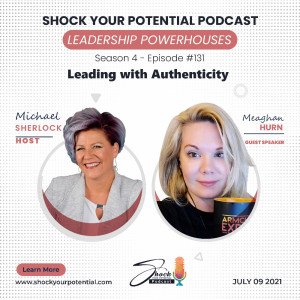
“We can’t change the whole world, but we can make our little corner slightly better, and that is what we are doing.” Meaghan Hurn
Publishing a book is considered to be one of the most significant steps towards becoming an author. This journey is not such a glamorous affair and entails long periods of hard work that require continuous collaboration from both the author and the publisher. Most writers sometimes end up frustrated with the process, but it doesn’t have to be so. This is according to our guest today, Meaghan Hurn, who believes that authors can be able to publish their books without going through all the frustrations that come with the process if only they know and understand their options in publishing.
Meaghan Hurn is the Founder and CEO of Hurn Publications, an Independent Publishing House that’s both collaborative with its authors and innovative in how it approaches the process of bringing books to life. Meaghan is big on giving back to the writing community outside of those who publish with Hurn Publications, and you’ll find on their website that they host Indie/Self-Pub Authors to help get the word out about their book. Meaghan supports the ProLiteracy Campaign to help adults learn to read and work their way out of poverty, and proceeds of the Hurn Publications online sales are donated to the program.
Hurn Publications operates with the belief that authors should be able to make a living at writing and selling books and has a hands-on approach in the pre and post-publication process with its authors. It’s actively trying to change the way the industry operates positively and sustainably. Hurn Publications has published works for HBO and has received awards and nominations from Writer’s Digest, Cohan, NY Times, and Publisher’s Weekly to start.
Additionally, Meaghan supports SoldiersAngels.org and has helped send over 50,000 packages to deployed military members during 2020 and continues to do so. In 2019 and into 2020, Hurn Publications developed the Princess Like Me and Prince Like Me Campaigns, a new approach to printing children’s books that allows all children from every ethnic background to find themselves the hero of the story.
In today’s episode, my guest will discuss the publishing options available to authors and why they should be making space for themselves to ask questions and understand the contracts they are given before committing to publishers.
Listen in!
Social Media:
https://facebook.com/HurnPublications
https://www.instagram.com/HurnPublications
Website: www.hurnpublications.com
We work hard for others [4:05]
We take a traditional approach as Indie publisher and we make it as collaborative as possible. [4:09]
The collaborative part is that I know every single one of my authors and they know me. [4:28]
They are part of this journey, and we never take it from them but we do it with them. [4:31]
If they have an idea, we bring it in because we are humans and not robots and therefore there is no way for us to know every single answer. [4:56]
Our authors come up with really cool things because who better know their book than the person who wrote it. [5:06]
We work really hard to make sure our contracts are author-friendly. [6:42]
One of the tips I have for leaders is to make space for themselves and authors should do that for themselves as well. [7:06]
Authors do have more choices but I don’t think they know it [7:53]
There is a lot you can do and don’t have to take the contract that you have been given [8:06]
When you come across more traditional offers, that advance, is more like a loan because your book has to pay that money back. [11:13]
I am hoping that more publishers will try and make it fairer. [11:46]
Our royalty rates are higher and they start out almost at their maximum. [12:02]
Most authors don’t know that they can negotiate or don’t have the confidence to take up that space for themselves and ask for more so we go ahead and do that for them. [12:10]
I have never met a business that can do it with just one person. [13:43]
It always seems that it is an overnight success but it isn't. It is years of work. [14:30]
Commercial Break [15:50]
I had to learn that while I don’t think I am intimidating, other people can think I am, so I have to give them the power to take up space for themselves. [17:00]
I let them know that they are not required to be right all the time. [17:11]
What we have had to deal with in 2020 is constant learning and being okay with change. This is hard for a lot of people sometimes more personal than it is in business. [19:07]
Schedule your day for when your brain is on fire. [24:06]
………………………………………………….
Thank you to our July Sponsor: Entrepreneur’s Guide to Financial Well-Being
Imagine starting a long journey without a map…or even a clear idea of the obstacles ahead. That’s exactly what it’s like for entrepreneurs who start companies with a lot of passion, but without the financial expertise to grow and scale their businesses and create long-term wealth for their families.
Wayne Titus shows you how to find a financial adviser who can help you map a better journey. In his book, The Entrepreneur’s Guide to Financial Well-Being. With the right adviser at your side, you’ll have the freedom to focus on what really matters to you.
Get The Entrepreneur’s Guide to Financial Well-Being at Amazon.com and in the virtual bookstore on the Shock Your Potential app.
Thursday Jul 08, 2021
Thursday Jul 08, 2021
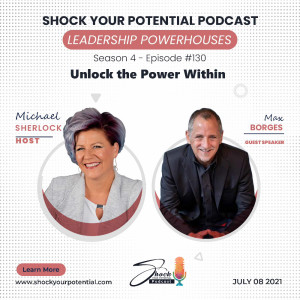
“You have never been qualified as you are today to start a business,” Max Borges
When in business, focusing on what you are good at and ensuring you have a great team is vital for growth and sustainability. Today, our guest Max Borges has the first-hand experience of running a business and insists that success is inevitable when people focus on doing what they are best at and surround themselves with people who can do things better.
Max Borges is an entrepreneur who in 2002 founded the Max Borges Agency – a tech-focused public relations firm. By studying the habits of business and strategy icons, he built his agency to more than 50 employees and $10 million a year in revenue. Max is also a tech investor, author of How To Be Fan-Fucking-Tastic! and host of the Unconventional Genius Podcast. Max lives in Miami Beach with his wife and three children and listens to heavy metal.
In today’s episode, our guest will discuss the importance of leaders focusing on their strengths when running their businesses and why it is crucial to eliminate any limiting beliefs and practices that hinder leaders from thriving.
You can find his book: How To Be Fan-f*cking-tastic!: Practical advice on how to stop sucking at life and start being Fan-f*cking-tastic!- https://amzn.to/3vwPJhJ
Listen in
Social Media
https://www.linkedin.com/in/max-borges-3ab2781/
https://www.linkedin.com/company/max-borges-agency
https://www.instagram.com/fan.fucking.tastic/
https://www.maxborges.com/
19 years ago, a company offered me a freelance gig which I took but only took me four hours a day. [2:52]
I got another freelance gig and rented a small office and hired some part-time help and then continued getting more clients and then slowly stepped it up. [3:18]
I felt I needed to make money while I can, and I have since made money for the last 19 years straight. [4:25]
For the first four years, we did any kind of marketing work we could get. [4:42]
After four years with ten employees and a million dollars in revenue, I realized I was stuck with too much and couldn’t grow. [4:55]
I had to figure out how I could scale the business. [5:21]
I read three books that all had a similar message: figuring out what you could be the best at. [5:27]
I made a list of all my happy clients and who did not require me to get involved and that my employees were handling without my input. [5:45]
I also made a list of my clients that were sucking me in and was requiring me to get involved. [5:58]
What I realized is, fortunately, the first list was about 70 percent of our business were consumer tech clients that we were doing media relations for. [6:09]
The other 30 percent were clients we were doing everything else for but took 90 percent of my time. [6:20]
I realized if I just did consumer tech relations, I’d have almost nothing to do, which would then free me up to work on my business and not in my business. [6:26]
I was nervous because I was not sure it was the right decision but that year we grew 74 percent and continued growing over the subsequent years. [6:50]
It got easier to run the business because now I got to do more business-building activities instead of business operating activities. [7:31]
You also have to focus on hiring great people that can focus on doing some things better than you. [9:18]
The most important thing you can do if you are building any professional firm where you are selling expertise is to commit and dedicate the time to hiring and developing great people. [9:47]
It is also essential that you believe in people’s potential, and I believe that people have far greater potential than they realize. [12:00]
I spent a couple of years collecting quotes which I published into a book, and so far, the response has been great. [14:23]
One of the quotes is, “It is never too late to start something great”. [16:30]
Many people think they have to start a business when they are eighteen or nineteen, but a lot of people start their business later in life. [16:40]
Commercial Break [19:05]
One of the quotes I have in my book is “life is an open book test”. [19:54]
In real life, we are constantly being tested, but we always have the resources to tap into in real-time whenever we want to. [20:23]
It also crucial that we surround ourselves with people who are experts in various fields who I can turn to for mentorship. [20:54]
It is not about what you know; it is about what you can figure out quickly. [21:35]
Rocket science is not rocket science anymore. [22:07]
Another one of my favorite quotes is, “don’t follow rules that don’t exist”. [23:32]
There are so many things that we do because we think it is a rule, but it is not really a rule. [24:17]
People are not afraid of failure; they are scared of humiliation and that people will laugh at them. [27:25]
We must do things that challenge us to strengthen that muscle of being fearless. [27:45]
Figure out what you can be the best at, and that will be your sweet spot.[31:05]
………………………………………………….
Thank you to our July Sponsor: Entrepreneur’s Guide to Financial Well-Being
Imagine starting a long journey without a map…or even a clear idea of the obstacles ahead. That’s exactly what it’s like for entrepreneurs who start companies with a lot of passion, but without the financial expertise to grow and scale their businesses and create long-term wealth for their families.
Wayne Titus shows you how to find a financial adviser who can help you map a better journey. In his book, The Entrepreneur’s Guide to Financial Well-Being. With the right adviser at your side, you’ll have the freedom to focus on what really matters to you.
Get The Entrepreneur’s Guide to Financial Well-Being at Amazon.com and in the virtual bookstore on the Shock Your Potential app.
Wednesday Jul 07, 2021
Wednesday Jul 07, 2021
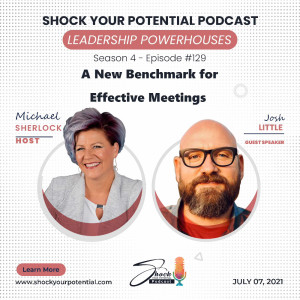
“Trust is such a big factor in leadership, and we learn to trust by how others act and how they show up in relationships” Josh Little
Communication is one of the critical elements that ensure effective collaboration and leadership. Considering the current work environment characterized by remote and hybrid working arrangements, communication between teams has become even more challenging. For these reasons and more, our guest today, Josh Little, believes in using the right technology that makes conversations more convenient and practical.
Josh Little is the founder of four tech companies–Maestro, Bloomfire, Qzzr (quizzer), and Volley–that have collectively been used by hundreds of millions of people. His work has been featured in Tech Crunch, Mashable, Entrepreneur, Inc., and Forbes. With two successful exits and a third pending, he’s currently on a mission to save the working world from death-by-meetings with his fourth creation, Volley.
In today’s episode, we will discuss what asynchronous video conversation is all about and the fantastic app Volley, which is making effective communication a reality for teams. We will also learn some of the leadership qualities that our guest believes are important in fostering great relationships with team members at work.
Listen in!
Social Media
https://www.linkedin.com/in/littlejosh/
I felt my mission in life is to create beautiful things and that could be a tech company, musical performance or a jar of pickles [2:30]
There is nothing as creatively satisfying as building a company even though it is intimidating and risky. [2:43]
Volley has been my most recent beautiful thing. [4:03]
Thinking about how to get the right information to the right people at the right time at work, is something that I have been passionate about for years. [4:30]
Leaders were going to have to adapt and figure out new strategies to lead, connect, talk and collaborate with their team. [5:00]
We can’t sort the problem with back to back zoom, because of burnout and fatigue. [5:08]
There are so many inefficiencies with the current construct that we call meetings. [6:31]
We are a lot more efficient at communicating by speaking than we are typing and for that reason at some point written communication fails. [7:10]
Volley is a video messaging App that allows professionals or teams to collaborate by sending video messages back and forth. [7:42]
We take turns just like any other conversation, except we record our turn with video. [7:54]
This option gives us the best of both worlds that is the richness of talking and the flexibility of texting. [8:00]
The beauty of Volley is we take those snippets of content and put them and call them a Volley where you create and send a Volley in a threaded conversation. [10:32]
The other members in the conversation can see your Volley and respond to it. [10:42]
A lot of teams have a stand up, or daily update of meeting. Instead of that being a scheduled thing, we do a stand up where everybody shows up. [10:50]
We want people to try Volley, it is a new technology and new way of thinking and working. [13:00]
We don’t want to be so presumptuous that we just know that this is exactly the way it needs to be compiled for use at work. [13:15]
So we knew a free product was necessary to the learning that we needed to do in order to create the product that we needed to create. [13:24]
We have many ideas for cool features, functionality and technology that we can infuse into this experience that people will be willing to pay for. [13:53]
We haven’t been working remote in the past three companies, because there was friction and breakdown in communication. [16:25]
I have been an aspirational remote worker and remote CEO for over a decade now so maybe VOLLEY is just me solving a problem by creating a tool that needed to exist to enable communication to just flow. [16:51]
While Volley is a great way to communicate, it is really for remote or distributed teams and hybrid teams that have some remote workers. [18:06]
Commercial Break [19:48]
The first one is do what you say you are going to do or say something else. [20:16]
The next one is playing with all cards on the table. [21:08]
That is the only way that we can get to the sort of understanding and clarity of what needs to be accomplished and why that matters. [21:49]
I have never been burned by vulnerability in any way. [22:12]
The new one is continuous leadership or on demand leadership and this is what Volley enables. [22:28]
You are only leading when interacting with your team. [22:41]
What we have been experimenting with Volley is the idea of continuous leadership. [23:18]
Only seven percent of communication is the words that we use, 38 percent is the tone and 55 percent is what we look like when we say those words. [25:12]
We are elite athletes at this thing called conversation and we need to talk to move forward. [25:50]
You should download Volley today because relationship and connectedness are important. [27:55]
………………………………………………….
Thank you to our July Sponsor: Entrepreneur’s Guide to Financial Well-Being
Imagine starting a long journey without a map…or even a clear idea of the obstacles ahead. That’s exactly what it’s like for entrepreneurs who start companies with a lot of passion, but without the financial expertise to grow and scale their businesses and create long-term wealth for their families.
Wayne Titus shows you how to find a financial adviser who can help you map a better journey. In his book, The Entrepreneur’s Guide to Financial Well-Being. With the right adviser at your side, you’ll have the freedom to focus on what really matters to you.
Get The Entrepreneur’s Guide to Financial Well-Being at Amazon.com and in the virtual bookstore on the Shock Your Potential app.

Title
This is the description area. You can write an introduction or add anything you want to tell your audience. This can help listeners better understand your podcast.